Roam Smarter with the

WAYB Travel Center

Guides, tips, and real-world advice for flying, road-trips, and everyday adventures with kids.

Choose Your Adventure

Pack lighter. Travel further. Together.

Airplane Travel

Yes! Anywhere the family goes, Pico goes. Airline-friendly, easy to carry, and quick to install once you're seated.

Road Trips

Wherever the road goes, Pico goes. It moves between vehicles in seconds and rides comfortably for the long haul, so road trips and rental swaps all feel like the same trip.

Caregiver Travel

Built for the handoff. Pico is light enough for any caregiver to carry on their own, and quick enough to install that pickups and drop-offs stay simple.

Wayb Family Travel

Guides & Resources

Explore tips and tricks for family travel, whether you're on the road or in the air.

Flying with Kids
 

The Federal Aviation Administration (FAA) is the governmental body responsible for the safety of civil aviation. Any car seat used on a plane must be approved for aircraft use and labeled accordingly.

  • Pico is certified for aircraft use and meets FMVSS 213 requirements.
  • Forward-facing installation is approved for airplane seats.
  • On planes, Pico installs with the aircraft seat belt only (no LATCH).
  • Designed for forward-facing use, for children age 2 and older who meet the height and weight requirements.

Child Size Requirements: These vary depending on the seat’s date of manufacture (DOM).

  • Seats manufactured before June 30, 2025: 22–50 lb | 30–45 in
  • Seats manufactured on or after June 30, 2025: 26.5–50 lb | 33.5–45 in

Check the label on the bottom of your Pico to confirm your seat’s date of manufacture. Click here for more information on DOM.

To install Pico on a plane:

  • Place Pico forward-facing in an airplane seat.
  • Unfold and lock the seat bottom before use.
  • Route the aircraft lap belt through the lap belt guides and buckle.
  • Pull the belt tight so the seat is secure with minimal movement.
  • Secure your child using the 5-point harness and chest clip.

NOTE: Pico installs using the aircraft seat belt only; LATCH is not used on planes

For plane installation video tutorials, click here.

Please reference your Pico manual for more details. Manuals can be found on the Safety Standards & Manuals tab of the WAYB Help Center.

Checklist for Families: 

1. Before you go, scan your airport's website or terminal map for family-friendly spots: 

  • Family security lanes 
  • Nursing or lactation rooms 
  • Family restrooms designed for strollers and young children
  • Airport play areas or open seating spaces
  • Info for gate-checking strollers and large gear 

2. See our tips & resources tab for full FAA and TSA guides 

Airline Policies: Check your airline's child restraint policy before booking. Links to major U.S. carriers below:

Car Seat Tips for Planes 

  • Book a window seat for the car seat. Airlines sometimes require this so it doesn’t block the aisle.
  • Check aircraft seat width before flying to ensure your car seat will fit.
  • Children must have their own ticket to use a car seat on a plane.
  • Practice installation before your trip so setup is quick onboard.
  • Booster seats cannot be used on airplanes because aircraft seats only have lap belts.
  • The FAA recommends car seats for children under 40 lbs during air travel.

Resources for Parents

Can I take my Pico on a flight?

The Pico meets all U.S. standards regulated by the National Highway Traffic Safety Administration (NHTSA) and Federal Aviation Administration (FAA). The Pico has been tested to meet all standards listed in FMVSS 213. 

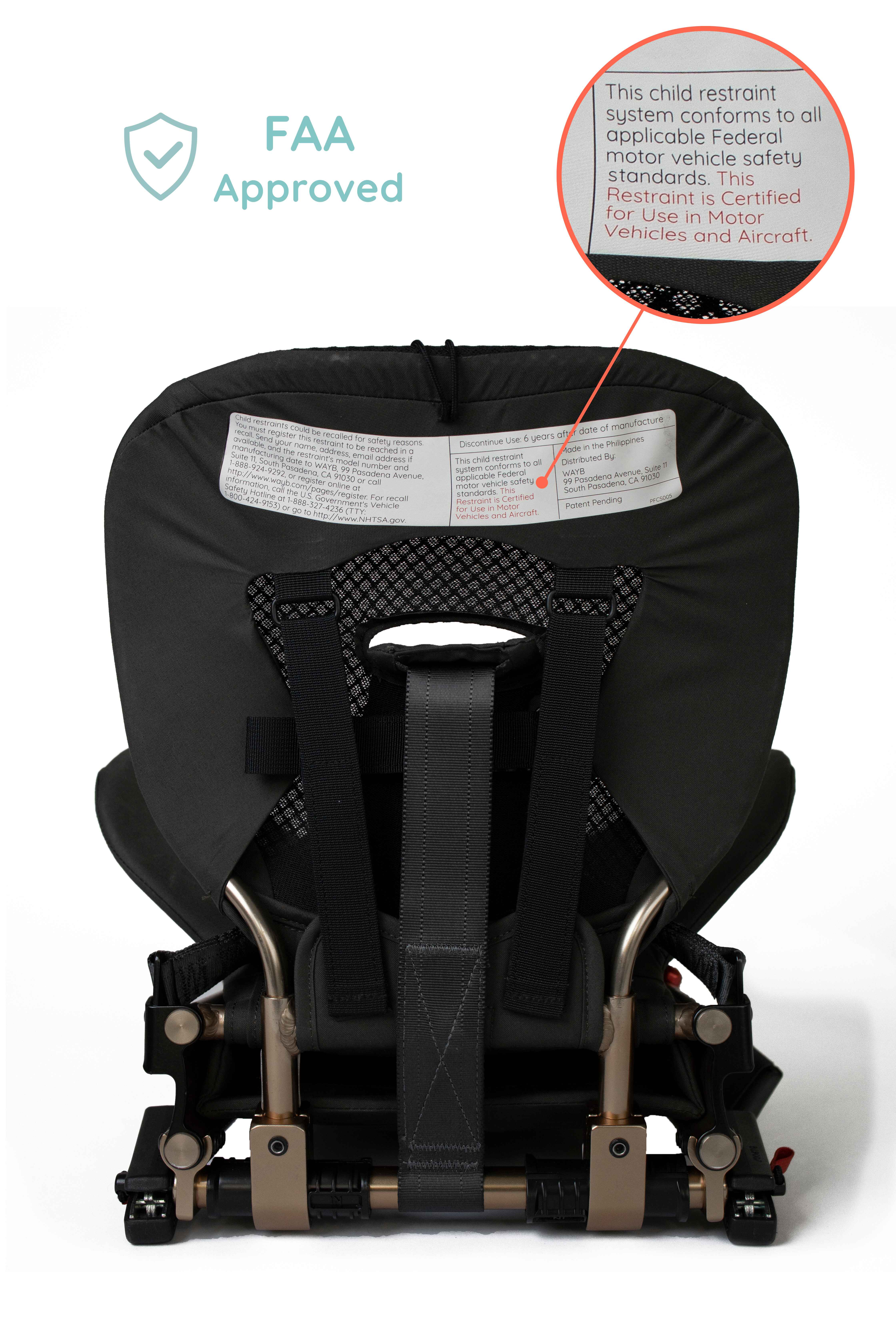
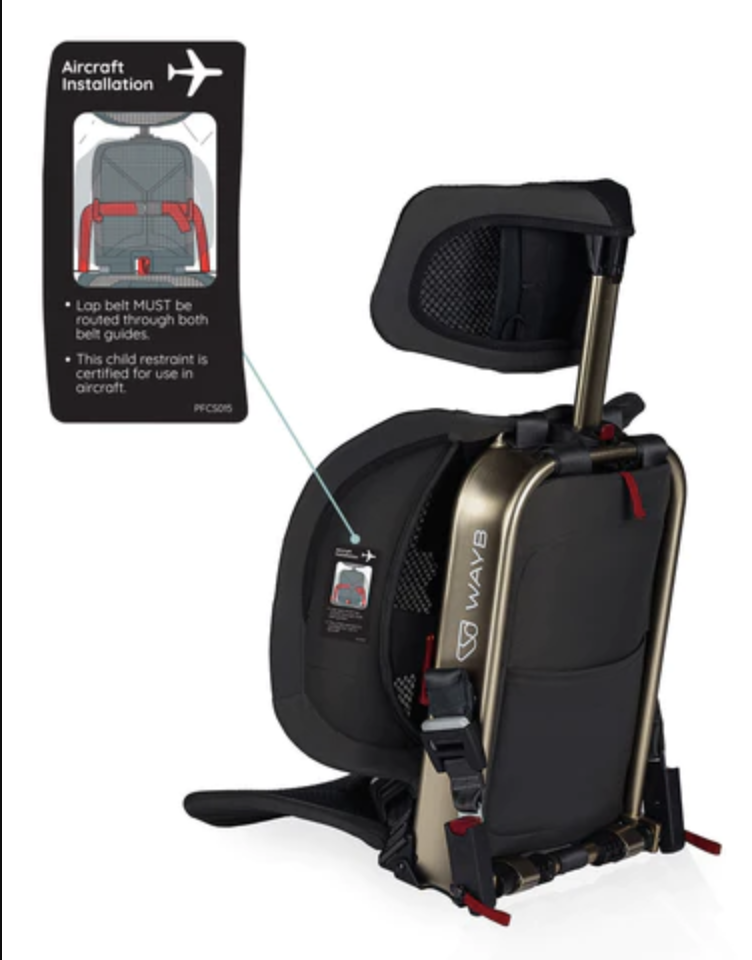
The Pico comes with a label located on the bottom of the seat that includes the standard wording required by the FAA, as well as the airplane symbol on the wing of the backrest. Please find two photos attached showing the labels and their locations on the seat. 

Every airline can vary in regulations, so WAYB and NHTSA highly recommend verifying with the airlines before your travels to ensure they will accommodate the seat.
What testing and safety protocols does the Pico follow?

The Pico car seat meets all U.S. standards regulated by the National Highway Traffic Safety Administration (NHTSA) and the Federal Aviation Administration (FAA). The Pico has been tested to meet all standards listed in FMVSS 213. We at WAYB have our own set of extensive internal testing and remarks to ensure the safest and best performance of the Pico. You can read more about this on our website here.

Child restraint manufacturers are required to self-certify that their products meet all the above-mentioned applicable safety standards and regulations set by the federal government to be allowed to be sold in the U.S. The Pico car seat has met all of these requirements. We take safety seriously at WAYB. Most importantly, we focus on safety for your kids and ours. We're proud to design WAYB products to use in our own families and would be honored to be a part of your family's journey.

Are the Packs TSA-friendly?

We designed our Daily and Mini Packs with effortless travel in mind! Both bags are TSA-friendly and can be easily taken through airport security, making them convenient for travel.

Check out our WAYB Packing Cubes and The Essential Zip Pouch Kit for your custom organization solution!

Does the Pico fit in overhead storage?

We made sure the car seat, whether inside the Carry Bag or on its own, is compact enough to fit nicely in the overhead bin or even under the seat in front of you in most commercial planes.

If you check the Pico, it can run the risk of being damaged by the baggage handling process. If the Pico is mishandled, this is not covered under our warranty, as written in the Breathe Easy Guarantee: https://wayb.com/pages/warranty.

For more FAQs, visit our Help Center.

On the Road
 

The National Highway Traffic Safety Administration (NHTSA) regulates motor vehicle safety in the United States. Car seats used in vehicles must meet the federal safety standards set by NHTSA.

  • Pico meets all U.S. federal safety standards set by NHTSA.
  • A 5-point harness and forward-facing installation keep kids secure on every drive.
  • Lightweight enough to move between vehicles in under a minute.
  • Designed for forward-facing use, for children age 2 and older who meet the height and weight requirements.

Child Size Requirements: These vary depending on the seat’s date of manufacture (DOM).

  • Seats manufactured before June 30, 2025: 22–50 lb | 30–45 in
  • Seats manufactured on or after June 30, 2025: 26.5–50 lb | 33.5–45 in

Check the label on the bottom of your Pico to confirm its date of manufacture. Click here for more information on DOM.

To install Pico:

  • Place Pico forward-facing in a vehicle seat.
  • Unfold and lock the seat bottom.
  • Install using LATCH or the vehicle seat belt.
  • Tighten until the seat moves less than one inch side-to-side.
  • Use the top tether whenever a tether anchor is available.
  • Secure your child using the 5-point harness and chest clip.

For installation videos, click here.

Please reference your Pico manual for more details. Manuals can be found on the Safety Standards & Manuals tab of the WAYB Help Center.

DOM stands for Date of Manufacture. It tells you when your car seat was made and determines which safety standards apply to your seat.DOM stands for Date of Manufacture. It tells you when your car seat was made and determines which safety standards apply to your seat.

  • The Pico has a 7-year post-DOM lifespan. Most manufacturers set expiration timelines between 6–10 years after the DOM. 
  • Car seats expire based on their DOM, not the purchase date.
  • The DOM label is usually located on the bottom or side of the seat near the model number.
  • The DOM may be earlier than the purchase date due to manufacturing and shipping timelines.
  • Check the label on the bottom of your Pico to confirm your seat’s DOM.

Click here to learn more about DOM.

Child in a car seat inside a vehicle with a cup.

Road Trip Tips

  • Plan regular stops so kids can stretch and move around.
  • Bring snacks, water, and activities for long drives.
  • Install the car seat before loading luggage.
  • Avoid bulky coats when securing the harness.
  • After a vehicle swap, give the seat a quick one-inch wiggle test.

Resources for Parents

What testing and safety protocols does the Pico follow?

The Pico car seat meets all U.S. standards regulated by the National Highway Traffic Safety Administration (NHTSA) and the Federal Aviation Administration (FAA). The Pico has been tested to meet all standards listed in FMVSS 213. We at WAYB have our own set of extensive internal testing and remarks to ensure the safest and best performance of the Pico. You can read more about this on our website here.

Child restraint manufacturers are required to self-certify that their products meet all the above-mentioned applicable safety standards and regulations set by the federal government to be allowed to be sold in the U.S. The Pico car seat has met all of these requirements. We take safety seriously at WAYB. Most importantly, we focus on safety for your kids and ours. We're proud to design WAYB products to use in our own families and would be honored to be a part of your family's journey.

How can I request a locking clip for my WAYB Pico car seat?

To request a locking clip for your WAYB Pico car seat, please provide your original order number or proof of purchase. The locking clip is a specific part that's used in vehicles that do not have seat belt systems that lock before a crash. In the U.S., all cars manufactured and sold since 1996 are required to have a passenger seatbelt system that locks car seats in place. Consequently, most cars you encounter will likely have this feature, and you shouldn't need a locking clip.

If you still wish to receive a locking clip, bear in mind that the Pico car seat meets all U.S. standards set by the National Highway Traffic Safety Administration (NHTSA) and the Federal Aviation Administration (FAA), and is tested to fulfill standards listed in FMVSS 213. However, it is not approved for use in international vehicles, with the exception of international flights departing from the U.S., where it is FAA-approved. If you are traveling internationally, we cannot recommend using the Pico abroad at this time.

If you decide to proceed with the request, please email your proof of purchase or original order number, along with your current mailing address, to our customer service team, who will be glad to assist you.

What if my Pico was in a car accident?

Car seats are damaged in vehicle crashes, and in many cases, the car seat must be destroyed and replaced. However, the National Highway Traffic Safety Administration (NHTSA) advises that if a child restraint (car seat) has been used in a minor crash that the child restraint can continue to be used.

NHTSA defines a minor crash, which a car seat can continue to be used after, as a crash where ALL of the following apply:

• The vehicle was able to be driven away from the crash site.

• The vehicle door nearest the car seat was not damaged.

• None of the passengers in the vehicle sustained any injuries in the crash.

• If the vehicle has airbags, the airbags did not deploy during the crash, and

• There is no visible damage to the car seat.

Damage to car seats may be difficult to see, or it may be difficult to verify the damage to the car seat. For those situations where any of the NHTSA Child Restraint Re-use criteria has not been met, or if there is uncertainty about whether damage to the seat has occurred, NHTSA and WAYB advise parents or caregivers to replace their car seat.

Contact your insurance company for information on their policy regarding car seat replacement after a crash.

Can the Pico be used in a golf cart?

Unfortunately, the Pico is not approved for Low-Speed Vehicles (LSV), such as golf carts. Even if there's a seatbelt present, the Pico has not been tested for that kind of vehicle, so we cannot guarantee safety or recommend use in LSVs. We cannot recommend any car seats for use with such vehicles.

How can I get a letter from WAYB stating that a car seat is no longer safe after being in an accident?

WAYB cannot provide individual letters for insurance purposes, but we can supply a PDF version of the relevant page from our manual that outlines the official statement on using the Pico car seat after car accidents. Please provide this document to your insurance company as needed.

For more FAQs, visit our Help Center.

Caregiver Travel
 

The National Highway Traffic Safety Administration (NHTSA) regulates motor vehicle safety in the United States. Car seats used in vehicles must meet the federal safety standards set by NHTSA.

  • Pico meets all U.S. safety standards regulated by NHTSA.
  • Pico’s forward-facing installation includes a 5-point harness that helps keep kids secure on the road.
  • Lightweight design makes moving between vehicles quick and easy.

Child Size Requirements: These vary depending on the seat’s date of manufacture (DOM).

  • Seats manufactured before June 30, 2025: 22–50 lb | 30–45 in
  • Seats manufactured on or after June 30, 2025: 26.5–50 lb | 33.5–45 in

Check the label on the bottom of your Pico to confirm its date of manufacture. Click here for more information on DOM.

Caregivers can install Pico using the same steps as parents:

  • Place Pico forward-facing in a vehicle seat.
  • Unfold and lock the seat bottom.
  • Install using LATCH or the vehicle seat belt.
  • Tighten until the seat moves less than one inch side-to-side.
  • Attach the top tether when available.
  • Secure your child using the 5-point harness and chest clip.

For installation videos, click here.

Please reference your Pico manual for more details. Manuals can be found on the Safety Standards & Manuals tab of the WAYB Help Center.

Tips for Parents 

  • Show caregivers how to install the car seat before the first trip.
  • Share the car seat manual or installation video so caregivers can reference it if needed.
  • Run through harness fit together: snug straps, chest clip at armpit level.
  • If a vehicle is used regularly, Pico can stay installed. If not, it reinstalls in under a minute.
  • Make sure caregivers know your child’s height and weight limits for the seat.

Tips for Caregivers

  • Buckle the 5-point harness before every drive, even the short ones.
  • Check that the car seat moves less than one inch side-to-side after installation.
  • Avoid bulky coats or blankets under the harness.
  • For a second set of eyes, check the manual or find a certified technician in the resources below.

Resources

What are the Pico's age, height, and weight requirements?
The Pico is a forward-facing car seat for children 2 years and up who meet the applicable height and weight requirements for their specific seat. The date of manufacture can be found on the label on bottom of your Pico car seat.

Seats manufactured on or after June 30, 2025:
  • Weight: 26.5–50 lb (12–22.7 kg)
  • Height: 33.5–45 in (85–114 cm)
Seats manufactured before June 30, 2025:
  • Weight: 22–50 lb (10–22.7 kg)
  • Height: 30–45 in (76–114 cm)

Please note: Seats manufactured before June 30, 2025 complied with FMVSS 213, and seats manufactured on or after June 30, 2025 comply with FMVSS 213 and the labelling requirements for 213b. The Pico is grandfathered in under these regulations and can continue to be used until its expiration date.

We take safety seriously at WAYB. Our roots are in the outdoor gear industry—an environment built on high standards for quality and safety. WAYB offers easy-to-follow installation videos on our support page, and recommends checking any car seat installation with a Certified Passenger Safety Technician in your area.
Can the Pico be cleaned?

Thanks to our mesh weave, you can spot-clean the Pico easily; the materials are also removable for deeper cleaning if desired! 

We recommend following the cleaning instructions listed on our website (also in the owner's manual) as often as necessary. We cannot recommend specific brands of cleaners but do recommend using a wool-safe detergent to spot clean or do a hand wash with warm water. If the stains cannot be removed, you can purchase replacement covers through our website.

Is the Pico forward-facing-only?

Yes, the Pico is a forward-facing-only seat not meant to recline or be installed rear-facing.

What testing and safety protocols does the Pico follow?

The Pico car seat meets all U.S. standards regulated by the National Highway Traffic Safety Administration (NHTSA) and the Federal Aviation Administration (FAA). The Pico has been tested to meet all standards listed in FMVSS 213. We at WAYB have our own set of extensive internal testing and remarks to ensure the safest and best performance of the Pico. You can read more about this on our website here.

Child restraint manufacturers are required to self-certify that their products meet all the above-mentioned applicable safety standards and regulations set by the federal government to be allowed to be sold in the U.S. The Pico car seat has met all of these requirements. We take safety seriously at WAYB. Most importantly, we focus on safety for your kids and ours. We're proud to design WAYB products to use in our own families and would be honored to be a part of your family's journey.

Can I get a new instruction manual for my product?

Yes, here is a digital version of the instruction manual. If you still require a physical copy, please provide your original order number or proof of purchase, along with your current mailing address. We will send you a new manual upon confirmation of your details.

For more FAQs, visit our Help Center.

How Pico Makes Travel Easier

Icon Feather

Compact & light. Weighs just 8lbs

Icon Plane

Fits in most airline overhead storage bins

Icon Checkmark

Passes all U.S. safety standards for cars & planes

Icon Backpack

Easy backpack-style transport in the Pico Carry Bag